
World Kidney Day (WKD), established in 2006 by the International Society of Nephrology (ISN) and the International Federation of Kidney Foundations – World Kidney Alliance, has grown into one of the largest global health awareness campaigns. Observed annually on the second Thursday of March, WKD aims to raise awareness of kidney health and reduce the growing global burden of kidney disease.
In 2026, WKD celebrates its 20th anniversary, offering a timely opportunity to reflect on progress while addressing emerging threats. The chosen theme—“Kidney Health for All: Caring for People, Protecting the Planet”—reflects a growing understanding that kidney health cannot be separated from planetary health, social equity, and sustainable healthcare systems.2
The Global Burden of Kidney Disease
CKD is one of the most common non‑communicable diseases globally, affecting over 850 million people worldwide. CKD significantly increases the risk of cardiovascular disease, premature mortality, reduced quality of life, and economic hardship. Despite its prevalence, CKD often progresses silently, with many individuals remaining undiagnosed until advanced stages.1,3
The burden of kidney disease is not evenly distributed. Disadvantaged populations, low‑ and middle‑income countries, and marginalised communities face higher risks due to limited access to clean water, healthcare services, early screening, and affordable treatments. These inequities directly challenge the goal of “Kidney Health for All.”1,3
Environmental Determinants of Health
Environmental change is increasingly recognised as a major driver of kidney disease. Rising global temperatures, air pollution, unsafe drinking water, and occupational heat stress contribute to both acute kidney injury and chronic kidney disease.4
Extreme heat and dehydration are strongly linked to kidney damage, particularly among outdoor workers in agriculture and construction. Air pollutants such as particulate matter and heavy metals have been associated with declining kidney function, while water contamination exposes populations to nephrotoxic substances. Climate change thus acts as a multiplier of kidney disease risk, particularly in resource‑limited settings.5
The Environmental Footprint of Kidney Care
Ironically, while environmental degradation worsens kidney health, kidney care itself can harm the environment. Dialysis is among the most resource‑intensive medical therapies, requiring large volumes of water and energy while producing significant plastic waste and greenhouse gas emissions.
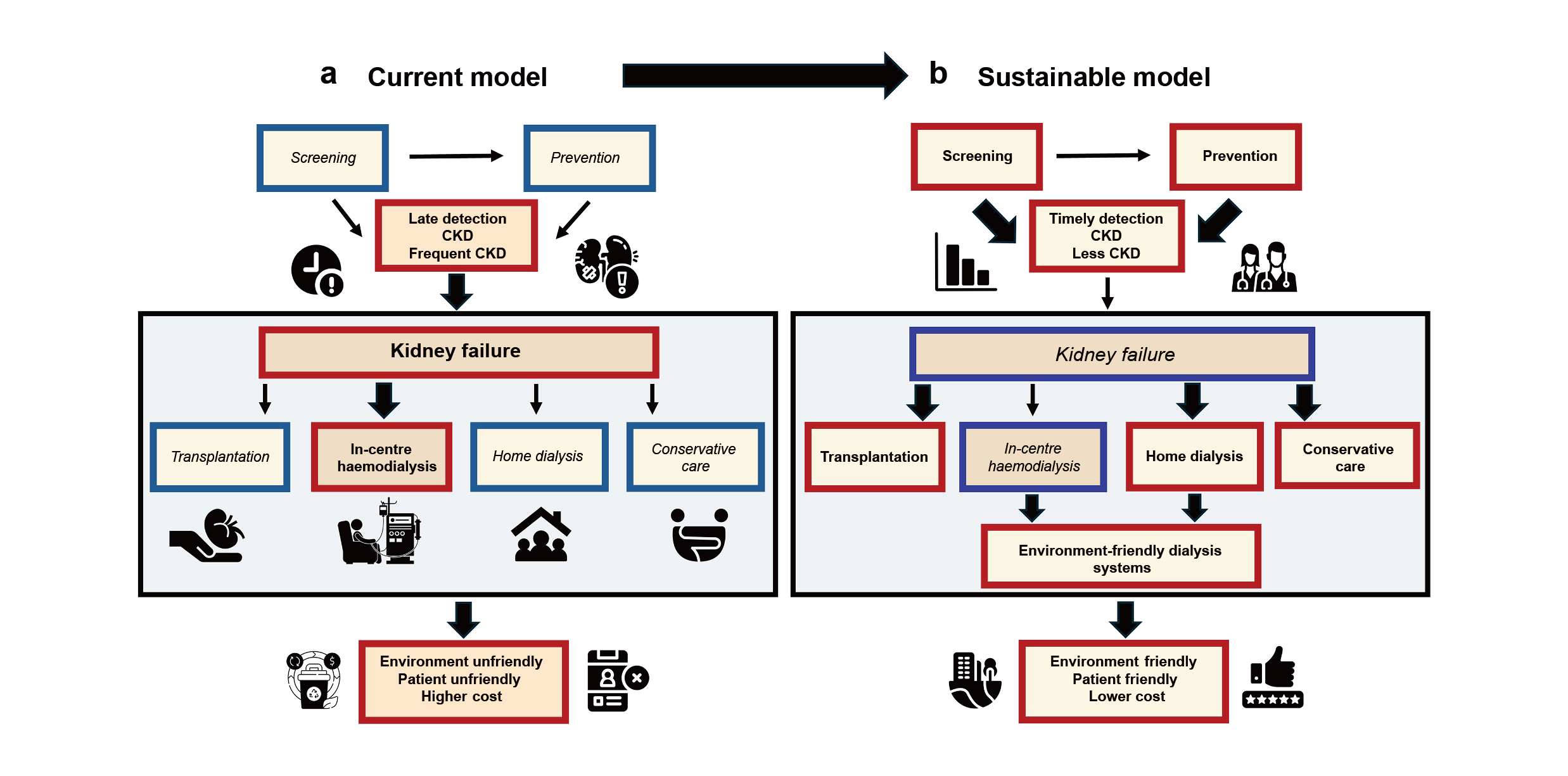 Adapted from: Vanholder R, et al. Kidney Int. 20261
Figure 1. (a) Current model of kidney care. (b) Sustainable model of kidney care.1 Elements that are less or insufficiently prominent in that specific model are in italics with a blue frame; elements that are prominent in the specific model are in bold with a red frame. Yellow background indicates “beneficial for sustainability”, and orange background indicates “disadvantageous”. Light blue–shaded box with black frame is used for kidney replacement therapy. The thickness of the arrows indicates the degree of impact on the given elements. CKD: chronic kidney disease; home dialysis: peritoneal dialysis and/or home haemodialysis
The healthcare sector overall contributes more than 5% of global carbon emissions, with dialysis recognised as a high‑impact contributor.1,6
As the global demand for kidney replacement therapy rises, especially in low‑ and middle‑income countries, the current care model is increasingly unsustainable. This reality underscores the urgent need for eco‑friendly, low‑carbon kidney care without compromising patient outcomes.7
Re‑imagining Kidney Care: Prevention and Early Detection
A central message of the 2026 theme is that prevention protects both people and the planet. Early detection of kidney disease—through blood pressure checks, diabetes control, and simple urine and blood tests—can slow disease progression and reduce the need for resource‑intensive treatments.1
Public health strategies that prioritise healthy diets, physical activity, reduced salt intake, and access to primary care can significantly lower the incidence and progression of CKD. By focusing upstream on prevention rather than downstream on end‑stage care, healthcare systems can reduce costs, environmental impact, and patient suffering simultaneously.1
Sustainable Kidney Care Models
Sustainable kidney care involves rethinking how services are delivered. Home‑based dialysis, transplantation, and conservative kidney management offer benefits for patients and the environment. Home therapies reduce transportation emissions, while kidney transplantation provides superior quality of life with a substantially smaller environmental footprint compared to long‑term dialysis (Figure 1).1
Innovations in“green nephrology,”such as water‑saving dialysis technologies, recycling programs, renewable energy use in dialysis units, and reduced single‑use plastics, demonstrate that environmental responsibility can align with high‑quality patient care. Scaling these solutions globally will require coordinated action among clinicians, policymakers, industry, and patients.8
Equity, People‑Centred Care, and Planetary Responsibility
“Kidney Health for All” emphasises that sustainable kidney care must also be equitable and people‑centred. Access to early diagnosis, essential medicines, dialysis, transplantation, and supportive care remains highly unequal across regions. Environmental sustainability should not become a barrier to care but rather a pathway to more resilient and inclusive systems.1
Empowering patients through education, shared decision‑making, and community engagement strengthens kidney health outcomes while fostering environmental stewardship. Protecting vulnerable populations from environmental harm is both a health and moral imperative.2
Conclusion
The 2026 World Kidney Day theme,“Kidney Health for All: Caring for People, Protecting the Planet,”reflects a powerful and necessary shift in global health thinking. Kidney health, environmental sustainability, and social equity are deeply interconnected. Protecting kidney health means addressing climate change, reducing environmental harm, preventing disease, and ensuring fair access to care.
As World Kidney Day marks its 20th anniversary, the global kidney community is called upon to act—by prioritising prevention, embracing sustainable care models, and advocating for policies that safeguard both human health and the planet. The future of kidney health depends not only on medical advances, but on our collective commitment to caring for people while protecting the world we all share.